


Russia Opens Terrorism Case After Mediterranean Gas Tanker Attacked
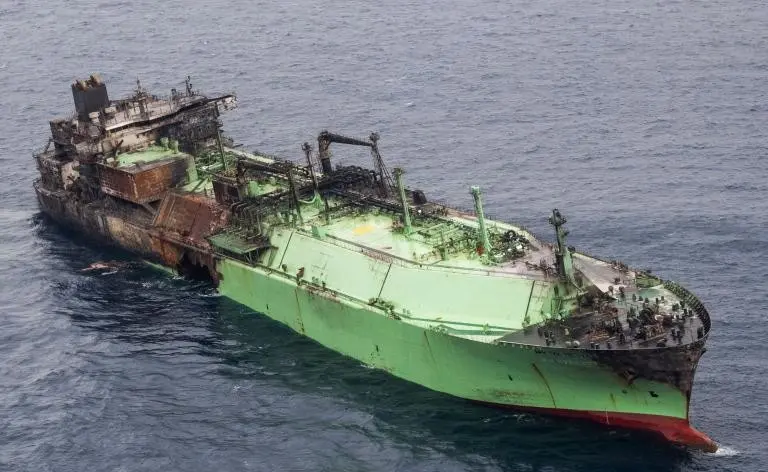
(FILE) The Russian Committee of Inquiry called international terrorism the attack suffered by the ship Arctic Metagaz, which remains adrift in the Mediterranean with considerable damage. Photo: Vesselfinder.
March 27, 2026 Hour: 5:28 pm
🔗 Comparte este artículo
The Russian Investigative Committee initiated a criminal case for international terrorism on March 27, following an explosion that struck the Arctic Metagaz gas tanker on March 3 in the Mediterranean Sea, leaving the vessel adrift with two injured Russian crewmen.
The Russia’s Investigative Committee confirmed this Friday, that it has opened a criminal case designated as international terrorism following a significant explosion aboard the Arctic Metagaz gas tanker in the Mediterranean Sea.
Spokesperson Svetlana Petrenko reported that the attack occurred on March 3 while the vessel was navigating its course from the port of Murmansk with its ultimate destination being China. This severe incident has prompted a swift and robust response from Moscow, signaling a heightened concern over the security of its maritime assets and the broader stability of international shipping lanes, especially for crucial energy shipments.
The assault on the Arctic Metagaz was executed using at least two unmanned aerial vehicles (UAVs) and three unmanned boats, all laden with explosives, which successfully impacted the structure of the Russian vessel off the coast of Malta.
At the time of the aggression, 30 crew members of Russian nationality were on board, two of whom sustained injuries and required immediate transfer for specialized medical attention. The calculated nature of the attack, employing advanced unmanned systems, underscores a sophisticated and deliberate attempt to disrupt Russia’s energy infrastructure and international trade routes.
Damage and Drift
Moscow authorities have already commenced interrogating all mariners who were present during the attack and meticulously examined video recordings that capture the direct aftermath of the detonations suffered by the cargo. The vessel was transporting 100,000 cubic meters of liquefied natural gas (LNG), a substantial amount that now poses a significant risk. Currently, the Arctic Metagaz remains adrift and is dangerously approaching the territorial waters of Libya, raising further concerns about potential navigational hazards and the urgent need for a safe recovery.
The ongoing investigation aims to uncover the full extent of the damage, analyze the trajectory of the attack, and definitively identify those responsible for what Russia categorizes as “an act of international terrorism”.
For his part, Kremlin Spokesman Dmitri Peskov strongly denounced the actions attributed to Kiev, characterizing them as “energy blackmail” that detrimentally affects the economic interests of numerous nations. Peskov specifically pointed out that this aggressive strategy impacts not only companies within the Russian Federation but also significant enterprises in the United States and the Republic of Kazakhstan.
This broad condemnation underscores the far-reaching implications of such attacks, suggesting a deliberate attempt to destabilize global energy markets and undermine the commercial viability of vital transportation networks.
Systematic Sabotage
The Russian Government reiterated that Ukraine has been systematically attempting to incapacitate the Caspian Pipeline Consortium (CPC), an entity deemed vital for the export of crude oil towards Western consumer markets. This ongoing campaign of disruption serves as a critical backdrop to the Arctic Metagaz incident, indicating a pattern of aggression against energy transit routes. As a reminder of previous incidents, last January saw reports of similar drone attacks against the oil tankers Matilda and Delta Harmony in the immediate vicinity of the strategic Black Sea maritime terminal. These earlier attacks highlight a sustained and coordinated effort to target Russian and related energy infrastructure in key maritime regions.
In this sense, the Kremlin emphasized that the increasing fragmentation of security across maritime routes places the stability of global supply and the physical integrity of civilian crews at severe risk.
Author: Laura V. Mor
Source: Agencies